The Starting Grid Is Not a Guarantee of the Finish
Starting grid position captures one moment, not the whole race. Learn when it matters, what can change it, and how to read a result in context.
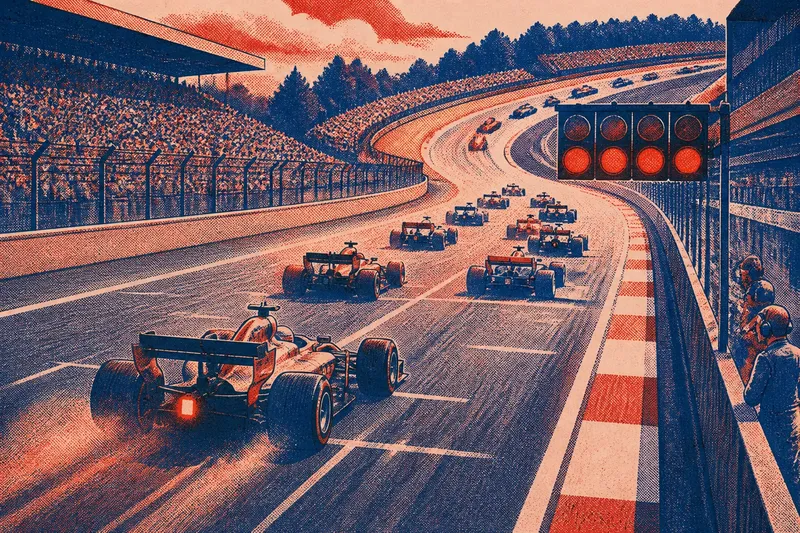
A driver rolls away from the grid in front, and the broadcast graphic makes the race look settled before the lights go out. Starting grid position does matter, but it records a particular moment in a race weekend—not a promise about where anyone will finish.
To read the gap between grid and result, first ask what kind of situation you are watching. Is the grid a close reflection of race pace, or has weather, traffic, a penalty, or a changing track rearranged the order? The answer changes how much weight that starting position deserves.
When does starting position closely reflect race pace?
In a straightforward weekend, qualifying gives a useful snapshot of how quickly drivers and cars can complete a lap under the conditions they face. A driver near the front has earned a favorable launch position and may have clear track ahead. That is an advantage, not a verdict.
This reading fits best when the circuit and conditions stay broadly consistent, the qualifying session runs cleanly, and the cars have similar opportunities to set a representative lap. Even then, a qualifying lap and a race ask different things of a car. Traffic, tire condition, fuel load, and the need to manage pace can change how well a qualifying order translates over the distance.
Think of the grid like a photograph taken at the moment the field is arranged. It tells you who is where in that frame; it cannot show what happens after the race begins.
When has the grid been reshaped by the weekend?
Sometimes the visible order is not simply the order produced by qualifying. A penalty may move a driver back, a mechanical problem may prevent a qualifying attempt, or a team may choose to start from the pit lane under the event’s rules. In those cases, the grid reflects both pace and circumstances.
Weather can make the snapshot less representative, too. A session interrupted by rain may leave some drivers with a dry lap and others without a comparable opportunity. A circuit that is gaining grip as cars run can also reward those who go out later, while traffic or a yellow flag can spoil a fast lap.
For this situation, separate the original qualifying order from the final starting order. Ask what changed and why before treating a driver’s position as evidence of their likely race pace. Event rules and team announcements can clarify the reason for an adjustment; details vary by series, so rely on the official event information where the rule matters.
What should you infer from a driver starting near the front?
A front-row start usually offers clean air and a short route to the first corner, but the opening moments are also where a strong position can become vulnerable. Drivers must react to the start, choose a line, and leave room for rivals. A car that launches well may gain places; one that spins its tires or gets boxed in may lose them before the first lap is complete.
Starting near the front is most informative when you want to know who has the early track-position advantage. It is less reliable as a prediction of who has the best long-run pace or will handle changing conditions well. Watch how the leading cars behave after the opening exchanges: can they maintain a rhythm, or do rivals stay close enough to apply pressure?
What does a low starting position tell you?
A driver starting well back may have qualified poorly, but the position alone does not explain the cause. They might have made a mistake, encountered traffic, struggled with the car’s setup, or received a penalty. Those explanations point to different prospects, so look for context rather than assigning one meaning to the grid number.
A back-row start can also make the first phase more complicated. Passing requires finding space, and a driver may lose time behind a group of cars even if their pace is stronger. On a circuit with few safe overtaking opportunities, that obstacle can persist; on a layout with several passing zones, there may be more room to recover. The track’s shape matters, but it still does not settle the outcome.
Imagine a driver qualifies near the back after traffic disrupts a clean lap, then starts in the same position because no penalty changes the order. If that driver shows consistent pace once clear of the pack, you might reasonably expect them to move forward when opportunities appear. The visible result to watch is whether they gain places without losing time in repeated battles—not an assumption that recovery is certain.
How do penalties, starts, and race conditions change the picture?
A penalty can alter a starting position without changing the car’s underlying speed. Conversely, a good qualifying result may be followed by a poor launch, contact, or a problem that forces a stop. The grid describes the arrangement before the race; the result reflects everything that happens after it.
As the race unfolds, consider three separate questions:
- Was the grid representative? Look at whether qualifying was clean and whether drivers had comparable conditions.
- Did the start change the order? Notice launches, first-corner traffic, and any immediate incident.
- What explains later movement? Consider pace, passing opportunities, interruptions, and any publicly reported issue.
This is not a scoring formula. It is a way to avoid treating a single position as a complete account of a race. A driver who loses places early and later recovers has had a different race from one who starts in the same place and steadily advances.
What questions help you read a starting grid?
Does pole position mean a driver will win?
No. Pole position gives the driver the leading starting spot, which can help them control the opening phase, but race pace and events on track still determine the result. Treat it as a favorable starting condition, not a forecast.
Why can a driver start farther back than they qualified?
A penalty or a decision to start from the pit lane can change the final starting arrangement. Check the official grid or event explanation to distinguish that change from a slower qualifying performance.
Can a driver start near the back and still finish near the front?
It is possible when the driver can make progress through the field, but the route depends on pace, available passing chances, traffic, and incidents. A low grid position identifies a challenge, not the final result.
Which matters more, qualifying pace or race pace?
They answer different questions: qualifying pace concerns a fast lap, while race pace concerns performance across changing laps and traffic. If you are judging likely progress, observe how the car behaves once the race is underway rather than relying on qualifying alone.
Which reading fits the race you are watching?
If qualifying was clean and conditions appear stable, use the grid as a sensible clue to early strength. If the session was disrupted, penalties changed the order, or the weather shifted, treat it as a record of circumstance as well as speed. If the start has already happened, the running order and the reason for its changes are more useful than the original grid by itself.
The starting grid is valuable precisely because it is specific: it tells you where each competitor begins under the event’s rules. Read it as the opening position in a changing contest, and you can appreciate both the advantage of starting well and the work required to turn that advantage into a finish.