Dirt Ovals and Paved Circuits: How Track Surfaces Shaped Racing
Dirt ovals and paved circuits create different racing rhythms. Learn what to watch for so you can choose a venue that suits your interests.
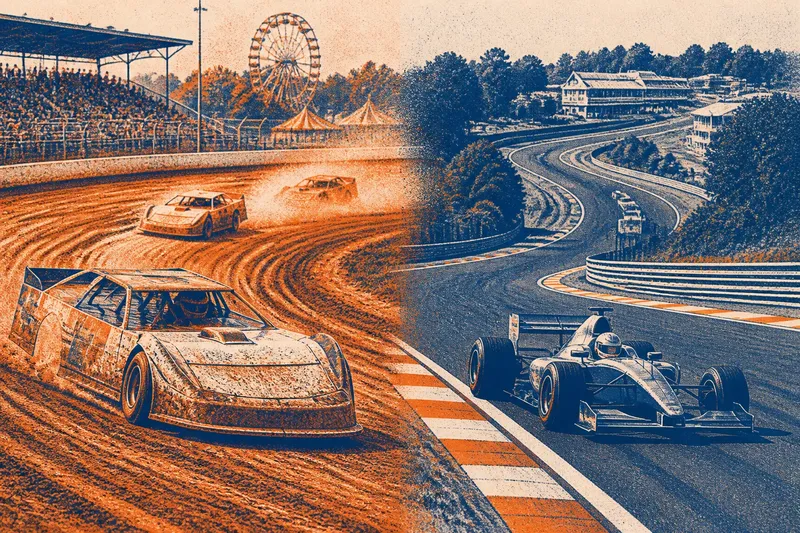
Dust lifts behind the cars as a dirt-oval race settles into its first laps, and the line through a corner begins to change. Dirt ovals and paved circuits give spectators different things to watch: on one, the racing surface can visibly develop; on the other, the designed route and its turns shape the contest.
That contrast is not a simple story of dirt disappearing beneath pavement. Local venues, permanent ovals, and road circuits have coexisted, each shaped by its purpose, setting, and racing traditions. Looking at their differences helps explain why a surface is more than a background.
Why did dirt ovals fit local racing?
In places where a level field or fairground was available, organizers could shape a loop without first building a paved course. Such venues could serve other public gatherings, too, tying race day to local routines and community life.
During a race, cars move loose soil, and traffic can form a preferred groove or leave ruts. Dust and moisture affect visibility and grip, so drivers respond to conditions that may shift as the event proceeds. Spectators can watch that relationship between car and ground develop corner by corner.
Weather and surface preparation also pose challenges: a dirt track may be too soft, dusty, or uneven for the planned event. Paving offers a firmer surface, but it does not remove the influence of weather, maintenance, or track design.
What did paving change at oval venues?
Consider the Indianapolis Motor Speedway, which opened as a brick-surfaced oval in 1909. Its later paving illustrates one specific venue’s change in surface; it should not be treated as a single timeline for every racing track. Elsewhere, dirt ovals continued alongside paved tracks rather than being replaced all at once.
On a paved oval, the surface is generally less visibly reshaped by passing cars than loose dirt. Banking, corner shape, width, and pavement condition still affect where drivers find grip and room to pass. The geometry becomes easier to read as a fixed feature, even though the racing itself remains dynamic.
A permanent oval can also be built around grandstands, pit areas, and access routes. The result is a venue organized for recurring events, with routines and a visual scale distinct from a loop temporarily marked out on open ground.
The difference resembles writing on a firm tabletop instead of on loose sand: the tabletop holds still, while the sand shifts under pressure. Neither setting dictates every move, but each changes what control looks like.
How do road circuits differ from ovals?
A paved road circuit links turns that may vary in direction and shape, along with straights and braking zones. Its route can test a car through repeated changes of direction rather than the continuous turning of an oval.
Some road circuits use public roads adapted for competition; others are purpose-built. Their sections connect into a route through a particular setting, so spectators may see only one part of the course while its broader character comes from how those parts fit together.
Each format offers a distinct focus. Dirt ovals make surface changes and local traditions especially visible; paved ovals emphasize repeated competition on a compact, continuous layout; road circuits invite attention to varied turns, braking, and route rhythm.
Which track should a first-time spectator choose?
Start with the detail you most want to follow. Choose a dirt oval if you are curious about a changing groove, a paved oval if you want to watch repeated close competition, or a road circuit if varied corners and changes in direction appeal to you.
Say you are choosing between a dirt race at a local fairground oval and a paved road-course event at a permanent circuit. Your stated interest is seeing how drivers respond to the track, and you have a clear view of one corner at either venue. At the oval, follow that corner as the groove becomes more or less distinct; at the circuit, follow how cars brake and turn through its different bends. If surface change holds your attention, the oval is the better fit; if changing corner demands matter more, choose the circuit. The observable difference is what you can follow from your seat, not a promise that one event will be more exciting.
- Observe whether loose soil is shifting into a visible groove; if it is, follow the groove through the race, and if it is not, watch how drivers choose their lines instead.
- Observe whether dust limits your view of the corner; if it does, choose a clearer sightline or track a section where cars remain visible, and if it does not, stay with the same corner to notice surface changes.
- Observe whether an oval’s banking is easy to see from your seat; if it is, compare how cars use the upper and lower parts of the turn, and if it is not, focus on the entry and exit instead.
- Observe whether a paved circuit has turns with visibly different shapes; if it does, compare braking and turning from one section to another, and if it does not, follow how the straights connect to the corners.
- Observe whether the venue’s layout lets you see more than one part of the course; if it does, compare how cars behave across those sections, and if it does not, choose one corner and watch its approach and exit.
- Observe whether track preparation or weather has changed the surface before the event; if it has, expect the visible conditions to matter to your observations, and if it has not, concentrate on layout and driver choices.
What do spectators ask about dirt and paved tracks?
Why can a dirt track change during a race?
Passing cars move loose material, while moisture and repeated traffic affect the surface. A groove or rough patch can become more or less prominent as the event unfolds.
Does a paved oval feel like a road circuit?
Both have hard surfaces, but their layouts differ. An oval repeats a continuous direction of travel, while a road circuit connects turns and straights that vary across the route.
Did paved tracks replace dirt ovals?
No single transition describes every venue. Dirt and paved tracks have continued side by side, with organizers and communities maintaining different racing formats and traditions.
What should I watch at my first dirt race?
Pick a corner and notice where cars run, whether a groove becomes clearer, and how dust or loose material changes what you can see. Following one section makes the track’s role in the race easier to recognize.
Dirt ovals and paved circuits are best understood as different ways of organizing a race, not as stages in a universal sequence. At your next event, look first at how the material meets the layout: a shifting groove, a banked turn, or a sequence of varied bends can tell you what the venue asks drivers and spectators to notice.