Open-Wheel or Closed-Wheel: What the Car Shape Changes
Open-wheel vs. closed-wheel racing cars reveal different clues about steering, traffic, and contact, helping you read what is happening as the field moves.
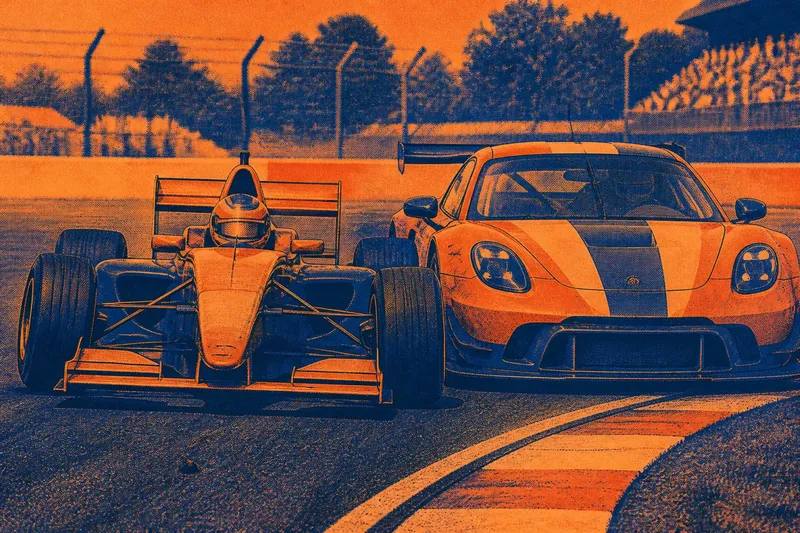
A car turns into a corner, and the driver beside it seems to leave almost no room. With an open-wheel car, the gap between the tires is plain to see; with a closed-wheel car, bodywork can make that same relationship harder to judge. Open-wheel vs. closed-wheel racing is not just a difference in appearance. Each shape puts different clues in view, and learning to read them makes the action easier to follow.
Why can two nearby cars look farther apart than they are?
The most visible distinction is the position of the wheels. On an open-wheel car, the tires sit outside the main body, with little or no fender covering them. A closed-wheel car surrounds its tires with bodywork, as on a sports car or touring car.
That changes the apparent outline. The nose, cockpit, and rear body may suggest the car’s width, but open tires extend beyond those shapes. In a closed-wheel car, the fenders mark the outer edge more clearly, although mirrors and other details can still add width.
When cars run side by side, compare tire edges rather than judging by the gap between their body panels. This is especially useful in a television shot from ahead or behind, where perspective compresses the space between cars. Think of two suitcases with handles that stick out: the cases may look clear of each other while the handles say otherwise.
In an invented example, say you are watching two cars approach a right-hand turn and their noses appear aligned. One is open-wheel, the other closed-wheel. If you follow the exposed tires and the closed car’s fender line, you can better see whether their paths overlap as they turn, rather than relying on the noses alone.
Why does wheel contact seem so consequential?
With open wheels, the tire is both a major visual landmark and an exposed part of the car. A small touch between tires can redirect a car, disturb its balance, or send it away from its intended line. The shape does not tell you exactly what a driver will do after contact, but it makes the point of contact easier to identify.
Closed-wheel bodywork can make contact look less direct. A bump may involve fenders or other panels, and the viewer may not see which tires touched, if any. Damage to the body can also become a visible clue: a bent panel or loose-looking piece may help explain why a car’s movement changes, though appearance alone cannot establish the underlying mechanical condition.
To read an incident, locate the first visible contact, then watch the cars’ paths and steering response. Avoid deciding that a driver was forced off course just because one car appears to move; camera angle, a correction, or a change in grip can create similar impressions. The exposed tire in an open-wheel race often makes the contact point more legible, not the cause or responsibility.
Why is it hard to tell which car has the better line?
An open-wheel car’s front tires show where its steering is aimed, at least in broad terms. Their angle can reveal a correction or a turn-in, while the rear tires offer another reference for how the car rotates. The wheel angle is not a direct display of driver intent, but it gives the spectator a useful cue.
On a closed-wheel car, bodywork hides much of that detail. You may see the nose move toward the inside of a corner without seeing the front tires’ exact direction. Instead, follow the car’s centerline, its position relative to the track edge, and how smoothly it changes direction.
A common viewing problem is treating the inside edge of the body as the car’s path. For either layout, track the tire contact patches when the camera shows them; if it does not, watch the car’s overall arc from entry through exit. A car that turns in early may still leave a wider exit, so a single frame is rarely enough to judge the line.
Why do open-wheel cars look more exposed?
The open cockpit and separated tires make an open-wheel car’s components and occupants feel close to the surrounding track. The driver’s helmet is visible above the body, and the suspension and wheels are often easy to distinguish. Those details can make steering corrections and the car’s response feel immediate to a spectator.
Closed-wheel cars enclose more of the driver and much of the wheel assembly beneath bodywork. A roofline, windows, and fenders give the car a familiar road-car silhouette, but they conceal some of the mechanical details. The car can seem more like a single shell moving through the corner, even though its tires and suspension still determine how it behaves.
Neither appearance tells the whole story about protection or safety. Racing vehicles are designed around their particular rules and use, and a spectator should not infer that one layout is categorically safer from its shape alone. For reading the action, the useful distinction is simpler: open-wheel design exposes more cues, while closed-wheel bodywork hides or softens them.
What viewing problems come from the camera angle?
A head-on camera can make an open-wheel car appear narrower than it is because the tires sit outside the body and perspective draws the far side inward. A side view can make the wheel placement obvious, but it may conceal how much space remains between cars across the track. In a closed-wheel view, the fenders usually help define the silhouette, while the hidden tire edges leave some uncertainty.
Look for a second angle when a pass or touch is unclear. A wide shot helps establish where each car is on the circuit; a closer shot can show steering, wheel movement, or body damage. If the broadcast offers only one view, follow the cars across several moments instead of treating a brief overlap as proof that one had room to complete a move.
There is also a scale problem when cars are distant. Open tires can look like small appendages rather than the car’s true outer edges, while closed-wheel bodywork presents a continuous shape that is easier to read at a glance. Use track markings, corner boundaries, and the relative movement of nearby cars as references, not just the apparent width of one vehicle.
Why do the two shapes change the feel of traffic?
In close traffic, open wheels make the clearance between cars visually prominent. A spectator can often see one tire approach another, or notice a driver leave a conspicuous margin. This can heighten the tension of a side-by-side run because the vulnerable-looking parts are in plain view.
Closed-wheel traffic can look more compact. Bodies may overlap in a camera shot, and fender edges can make cars seem to brush even when the tires remain apart. The viewer may need to watch for a change in direction, a wobble, or a sudden gap before deciding that contact occurred.
In both cases, the shape is a guide to what is visible, not a complete account of the driving. The cars’ relative speed, the corner’s width, and the line each driver chooses all matter. When the picture is ambiguous, describe what you can see—overlap, a correction, a changed trajectory—before assigning a cause.
What questions help you read the car shape?
Are all open-wheel cars built the same way?
No. Different series have different bodywork, cockpit arrangements, and technical rules, so the amount of visible wheel and suspension detail varies. The useful starting point is whether the tires sit outside the main body, not whether every open-wheel car shares one exact silhouette.
Does closed-wheel mean the tires are completely hidden?
No. The tires remain visible below or within the fenders, and their edges can be clear in a low or side-on camera shot. “Closed-wheel” describes the bodywork around the wheels, not an opaque cover over them.
Can body damage tell me what happened?
It can offer a clue, such as a marked fender after close running, but it seldom identifies the cause by itself. Look for the moment of contact and the cars’ motion before and after it; a damaged-looking panel may have another explanation.
Which layout is easier to follow as a new spectator?
That depends on what you want to notice. Open-wheel cars make tire placement and steering cues more obvious, while closed-wheel cars offer a familiar body outline that can make a field easier to distinguish at distance.
How can you use the shape without overreading it?
Start with the outer edges: exposed tires on an open-wheel car, fenders on a closed-wheel one. Then watch where the front tires point, how the car’s path changes through the corner, and whether a rival’s trajectory overlaps it. These observations can help separate a close pass from contact, or a deliberate line from a correction.
Keep the limits of the view in mind. A car’s shape can make some details easier to see and others harder, but it cannot show grip, a driver’s intention, or the full forces at work. Open-wheel vs. closed-wheel racing becomes easier to read when you treat the silhouette as a set of clues, then check those clues against movement over time.
Next time the field bunches up, choose one pair of cars and follow the tire edges through a corner. That small habit turns the outline from decoration into useful information—and leaves room to say “unclear” when the camera has not shown enough.