A First Race Watch: Follow the Pit Lane
A first race watch becomes easier to follow when you track the pit lane, crew activity, and timing screen together, without mistaking a temporary order for the result.
At a first race, the cars may rush past before you can tell which one you were watching. A first race watch gets easier when you follow the pit lane and compare its activity with the timing screen, rather than trying to read the entire field at once.
What does the pit lane do?
The pit lane is the controlled area beside the track where cars enter or leave the circuit and stop for service. Its layout varies by venue, but it usually runs alongside a straight and includes marked spaces for teams, often called garages or pit boxes.
A visit may be scheduled or prompted by a repair, tire change, changing conditions, or a race-control instruction. Cars still on the circuit continue racing, so a stop affects a car’s immediate position even when its reason is routine.
Think of the pit lane as a busy hallway beside a workshop: the hallway has traffic rules, while each garage has its own work to do. Looking from the lane to a timing display helps connect those separate activities.
Where should you look during a first race watch?
Choose one car and remember its number, color, or team marking. Then shift your attention among the car on track, its team’s pit area, and the timing screen. This gives you a simple loop to return to when the field spreads out.
At the venue, use the spectator map to find a safe public viewing area with a view of pit entry or exit. Public access to the working lane varies, and many areas are restricted. On a broadcast, notice when the camera moves from the circuit to a garage, then check whether a graphic identifies the car or team.
You do not need to follow every competitor. If the view is crowded, use the timing screen to confirm a car’s status rather than trying to read small markings from a distance.
Who works in the pit area?
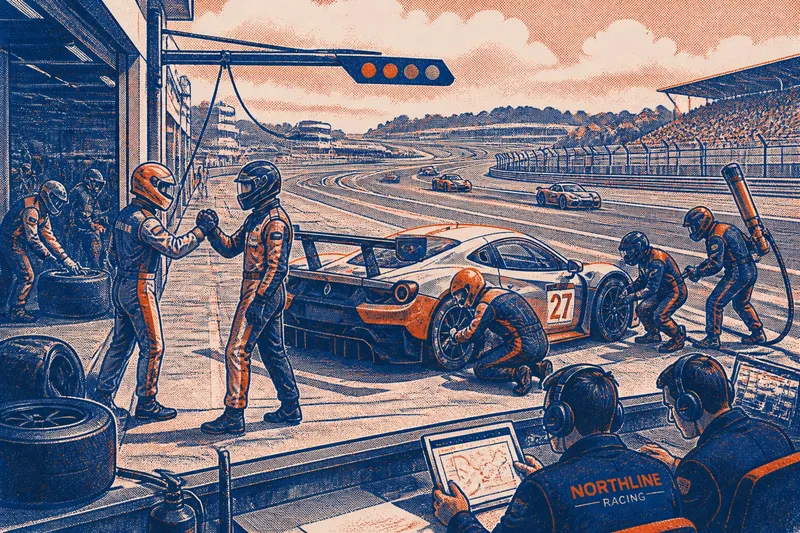
The crew coordinates tasks rather than simply waiting for a car. Depending on the series and the work required, team members may handle tires, inspect the car, communicate with the driver, or monitor equipment and timing. A crew chief or equivalent lead helps coordinate the work, and someone responsible for release checks that the car can leave safely.
Some roles are easier to recognize than others. Tire crew members gather near the wheels when a stop is expected; a person with a radio may relay information; engineers may review screens or speak with the driver. Roles and permitted tasks differ between series, so movement alone does not always reveal a person’s job.
Preparation can be visible before a car arrives: crew members may bring equipment into position, then clear the area after the car leaves. That change suggests the team anticipated work, but it does not necessarily tell you why the car stopped.
What can you observe during a pit stop?
A stop begins when a driver leaves the racing surface and enters the pit lane, then slows for the assigned work area. The crew carries out service allowed by the series and the situation. Once the work is complete and the team signals that the way is clear, the car returns to the circuit.
Follow the sequence rather than trying to interpret every tool. Does the car pause briefly or remain while the crew works? Do team members focus on one area, or do several act at once? These details let you describe what happened without assuming its cause.
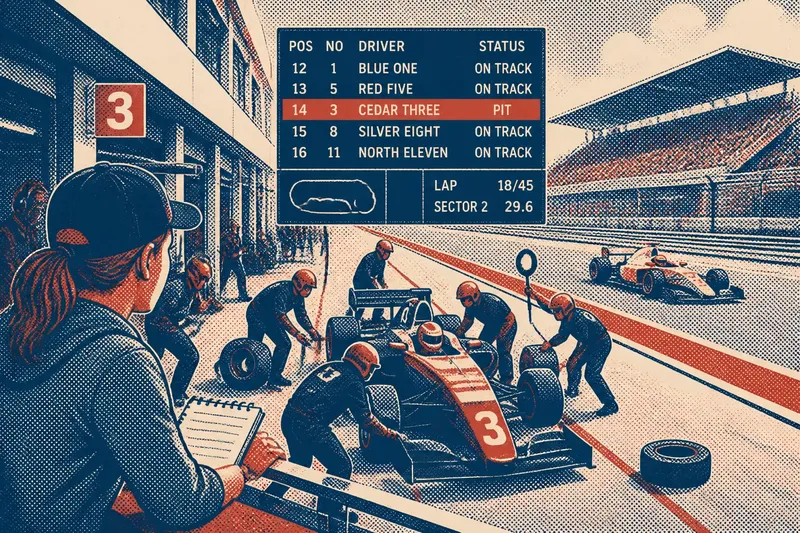
Imagine you are following an invented car called Cedar Three. At the start of your observation, the timing screen places it just behind a group of cars, and its entry is marked “pit.” You watch it stop at its garage, then see the crew change a tire before the car returns to the track. On the next timing update, Cedar Three appears lower in the order; that is the observable result, while the screen alone does not tell you whether it will regain places later.
A longer stop might involve extra work, a delay, or a team decision, but a spectator cannot always tell which. Treat commentary or official timing as the source for confirmed explanations, and keep your own interpretation separate.
How does a stop change the timing screen?
A car’s displayed position can change while it is in the pits because other cars continue around the circuit. During a sequence of stops, the order may be temporary: a car that has already visited its crew can appear behind rivals that still need to stop.
Look for labels such as “in,” “out,” or “pit,” if the display provides them. Compare a car’s status with nearby entries rather than treating one moment’s order as settled. Timing graphics differ by series and broadcaster, but they can help distinguish a car on track from one in the pit lane.
Position and lap or sector time describe different things. Position shows a car’s current rank; timing fields describe its progress through the event. A car may lose a place during a stop and later recover it, or remain behind. Watching the order change is more useful than assuming a stop predicts the finish.
What should you check when the pit lane gets busy?
Several cars may arrive close together, crews may prepare at once, and drivers may rejoin while others approach pit entry. Use these observations to keep track of events, not to judge whether a team has followed every rule.
- Before a stop: Check whether crew members and equipment are already in position. If they are, expect a prepared service; if not, keep the reason for the stop open until you see more.
- At entry: Check where the car leaves the racing surface and whether its status changes on the timing display. If the display marks it as entering, follow its garage activity; if it does not, wait for a clearer update rather than guessing from a distant view.
- At the work area: Check which part of the car the crew approaches. If the task is visible, describe that action; if it is obscured, rely on commentary or leave the task unidentified.
- At release: Check whether the crew clears the car’s path and whether it returns to the circuit. If it leaves, follow its new status; if it remains, watch for an official or team explanation rather than inferring a fault.
- Afterward: Check the car’s status and position on the timing screen. If the order has changed, note the current place without treating it as final; if the display is unclear, wait for the next update.
- From a spectator area: Check venue signs and staff directions before moving closer. If the area is marked public, stay within its boundaries; if access is restricted or uncertain, remain in the designated viewing area.
Pit-lane speed limits, release procedures, and permitted work depend on the series and event. Follow venue instructions, and rely on race control or the broadcast for decisions about rule compliance.
Why might a car enter the pit lane?
A car may stop for routine service, a tire change, a repair, or an adjustment. A team may also respond to weather or a race-control instruction, or bring a car in according to its planned approach to the event. A car that appears to be running normally may still have a scheduled visit.
Sometimes the reason is visible: a damaged body panel may be apparent, or the crew may clearly change a tire. Sometimes it is not. If commentary does not provide a reason, leave the question open instead of inferring trouble from a longer pause or a change in order.
What do first-time viewers ask about the pit lane?
Can a car leave the pit lane ahead of another car?
It can, depending on where the cars are and the rules governing release and traffic. Timing graphics or official commentary can clarify the order, while a view from one spot may show only part of the situation.
Does every car have to make a pit stop?
That depends on the series, event format, and applicable rules. Some races require particular service or tire use, while others allow teams more choice; official event information is the clearest guide.
What does it mean when a car stays in the pit area?
It may be receiving repair work, waiting for a decision, or being held for another reason. The team or race officials may explain the delay, but the wait alone does not identify its cause.
Can spectators walk into the pit lane?
Only when the event specifically allows access, such as during an authorized tour or open session. Follow venue signs and staff directions, and stay out of working areas unless access is clearly permitted.
How can you keep following a car after a stop?
When your chosen car returns to the track, check its status and position, then look for it on the next lap or broadcast camera shot. If it is hard to spot, use its number or team color rather than scanning the whole field. A short note on your phone—car, stop, and updated position—can help you reconnect with the race.
For a first race watch, following the pit lane gives you a useful thread through the event. Track one car, compare visible activity with the timing screen, and separate confirmed information from guesses. Remember that pit-lane observations clarify what a car is doing now; they do not settle what will happen next.